
The True Cost of Inaccurate Site Measurements (and How 3D Building Scanning Saves Money)
- April 12, 2026
- Posted by: admin
- Category: 3D Virtual Tour
When working on a project, the real cost of bad information often only becomes visible once something has gone wrong on site. Whether it’s a wall slightly out of line, a beam that sits lower than expected or a room that’s smaller than the drawings suggest, it can trigger redesigns, delays and awkward conversations with clients.
These issues usually come back to the same cause: site measurements that were incomplete, out of date or simply wrong. For this reason, more project teams are prioritising accurate measurements. Modern 3D building scanning is a cost-effective investment. It captures the true conditions of your site in a way that traditional tape measures and spot checks can’t, giving everyone a reliable starting point and reducing the likelihood of expensive surprises later on.
Why Accurate Measurements are More Important Than Ever
Nowadays, budgets are tighter, timelines are shorter, and projects are often more complex than they appear at first glance. From refurbishments to fit-outs and extensions, projects have to work around existing structure and services, and any assumption can cause significant problems. Being ‘a few millimetres out’ isn’t just a harmless rounding error – it’s a risk to margins, deadlines and relationships.
At Surveyhands Engineering, we regularly see how small inaccuracies cause issues as a project moves from sketch to site. These issues are rarely isolated too; each one adds redesign time, potential variations, and pressure on the timeline. For this reason, 3D building scanning is a sensible way to reduce risk and replace guesswork with highly detailed site data.
Common Causes of Inaccurate Site Measurements
Even experienced teams can end up with incorrect data, simply because of how traditional surveys work.
Time-Pressed Manual Surveys
On busy projects, manual surveys are often squeezed into short windows. Teams rush around with tape measures or handheld lasers, capture the key dimensions, and hope they have enough to create drawings. Hard-to-reach areas might be skipped, complex junctions simplified, and anything awkward is estimated as ‘near enough’. This approach feels quicker at the time, but often leads to gaps that cause problems in the long run.
Out-of-Date or Missing As-Built Drawings
Existing buildings can come with a long history of undocumented changes. Whether tenants reconfigure layouts, services get diverted, or small adjustments accumulate over decades, drawings might show the original design rather than what is actually there. Often, as-built drawings are missing altogether. Relying on these records without verifying them on site is a common cause of surprises when work begins.
Complex or Occupied Sites
Some environments are simply difficult to measure accurately by hand. From irregular geometries to service-heavy ceilings, several factors can make it harder to capture a complete picture. In occupied buildings, surveyors might also be limited by access times or health and safety constraints. Important details are easy to miss when you are working around staff, equipment or the public.
The Hidden Costs of Bad Measurements
The real impact of inaccurate measurements tends to show up once work has already begun, when it’s most expensive to fix.
Design Rework and Changes
When unforeseen clashes and constraints emerge, design teams have to revisit drawings, models and calculations. This extra design work is rarely in the initial budget. On top of the financial costs, clients experience variations and design revisions that can erode trust, especially when the issues appear avoidable with better information from the outset.
On-Site Delays and Overruns
If something doesn’t fit on site, trades often pause while the problem is investigated. Temporary solutions, redesigns, and approvals all take time, which can put the whole project on hold. This delay can push subsequent plans out of sequence, increase preliminary costs, and put pressure on contractual milestones or handover dates.
Material Waste and Extra Labour
Components fabricated to fit a specific space often need to be cut, adapted, or remade once the actual conditions are known. This means wasted materials, overtime and extra visits, as well as the intangible cost of site teams ‘making it fit’ under time pressure. Individually, these fixes might seem small, but collectively, they eat into contingency and profit.
Health, Safety and Compliance Risks
Misjudged clearances and incorrect levels can also have safety implications. Services installed too low or too close together can create maintenance hazards. Non-compliance with fire or access requirements can lead to remedial works, inspections and, in the worst cases, enforcement action. Many of these issues trace back to inaccurate information.
What Is 3D Building Scanning?
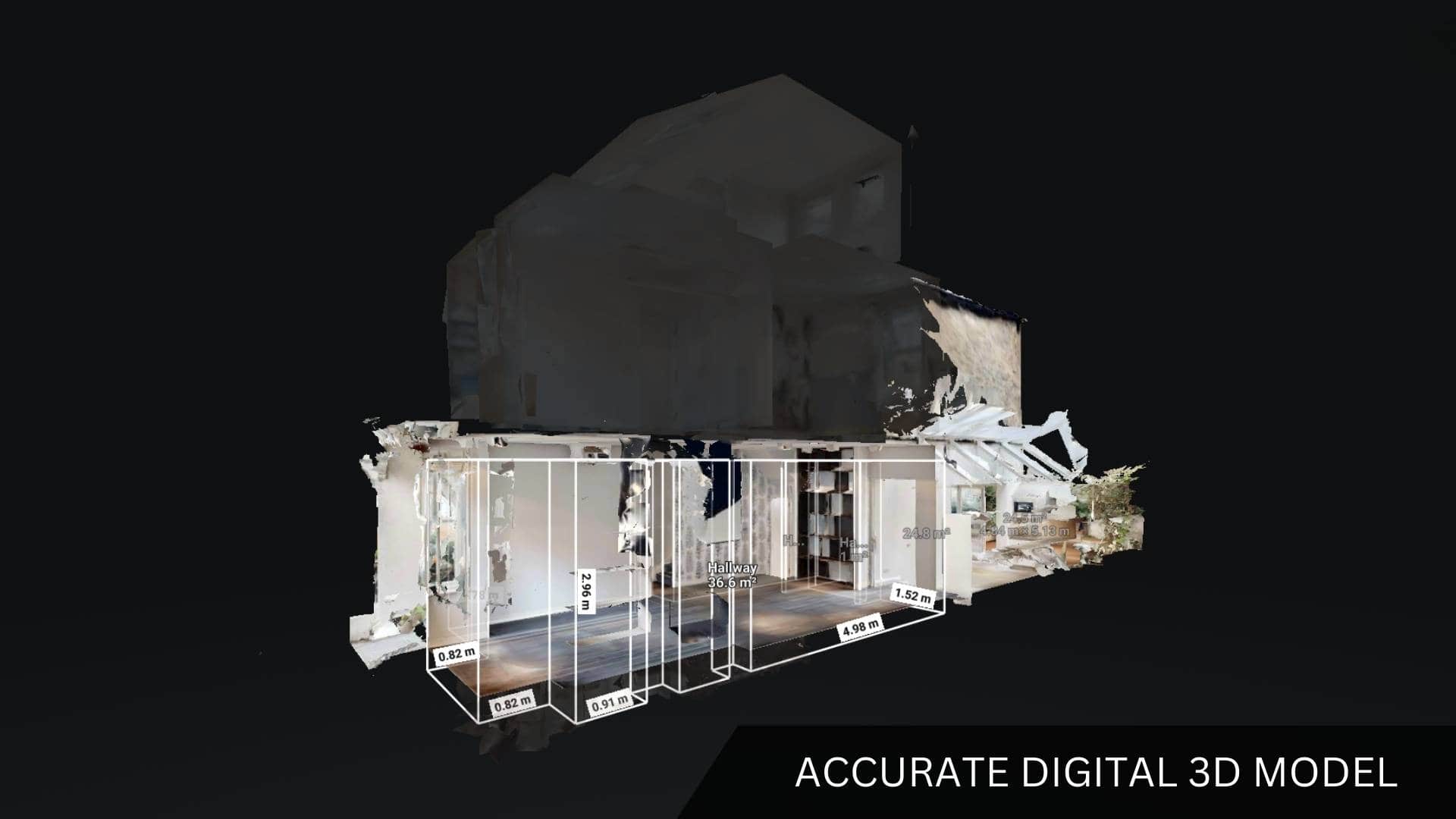
3D building scanning uses laser scanners to capture data across a site, creating a dense ‘point cloud’ that represents the exact geometry of the building. Instead of collecting isolated dimensions, you get a highly accurate 3D picture of walls, floors, soffits, services and structural elements, inside and out.
From the point cloud data, 3D building scanning services typically deliver outputs such as CAD drawings, BIM models, SketchUp models, and 360° virtual tours. Architects and engineers can design directly from this data, confident that what they are seeing matches what’s actually there. Contractors and project managers use the same information to plan sequencing and check that work stays aligned with the design as construction progresses.
How 3D Building Scanning Prevents Costly Errors
Accurate 3D data capture changes the way risk is handled on a project.
Capturing the Whole Site in One Go
Instead of selective measurements, 3D scanning of a building’s interior and exterior captures the entire environment in a single, coordinated dataset. Complex geometries, awkward corners and congested spaces are all recorded, not just the ‘easy’ parts. This reduces the need for repeat visits and removes much of the guesswork that causes errors later.
Reducing Clashes Before You’re on Site
Since laser scan data is used to create detailed models, coordination between disciplines can happen earlier and with more confidence. Structural, architectural, and MEP teams will work from shared, detailed 3D models or drawings, enabling clash detection before work starts. Fixing a clash at this stage helps prevent days of disruption on-site.
Supporting Prefabrication and Off-Site Manufacturing
Prefabricated elements only deliver their promised savings if they fit the first time. With 3D building scanning, fabricators can work to actual tolerances rather than relying on unreliable dimensions. This reduces the number of on-site fixes, improves overall quality, and unlocks more opportunities for off-site solutions without increasing risk.
Creating Reliable As-Builts for Future Work
Once a scanning project is complete, the data can be used for years to come. Accurate as-built documentation supports maintenance and future refurbishments without having to start each project from scratch. Over the lifespan of a building, this can mean fewer repeat surveys, less disruption to occupants, and a consistent digital record that everyone can trust.
When Does 3D Building Scanning Make Financial Sense?
In theory, every project benefits from better information. In practice, some situations make 3D building scanning an especially strong commercial choice.
- High-risk and high-value areas, such as historic structures or buildings where downtime is expensive. In these cases, the cost of a mistake is measured not only in materials and labour, but also in lost revenue, reputational impact and extended timeframes.
- Refurbishments and fit-outs are another clear use case. Working around existing fabric and services means there’s less tolerance for error, and new works must align precisely with what is already there.
A Simple Value Calculation
One way to assess value is to compare the cost of scanning against the cost of a single serious error. If a 3D scan of a building interior prevents just one major clash – for example, avoiding re-routing a significant run of ductwork or remaking a bespoke staircase – it can pay for itself several times over. This is before you even factor in other savings, such as reduced stress on the team, fewer difficult conversations with clients, and stronger confidence in future projects.
Saving Money with 3D Building Scanning Services
Accurate measurements are key to the successful outcome of a project, and inaccurate site data can lead to hidden costs. By using 3D building scanning, you can significantly reduce risk while protecting margins, timeframes and reputation at the same time.
If you’re currently relying on old drawings or rushed manual checks, it might be worth exploring 3D laser scanning services for your project. Contact our team at Surveyhands Engineering to find out more about how 3D building scanning can help save you money.