
How 3D Laser Scanning Can Help Avoid Site Re-Visits and Delays
- March 19, 2026
- Posted by: admin
- Category: Laser Scanning
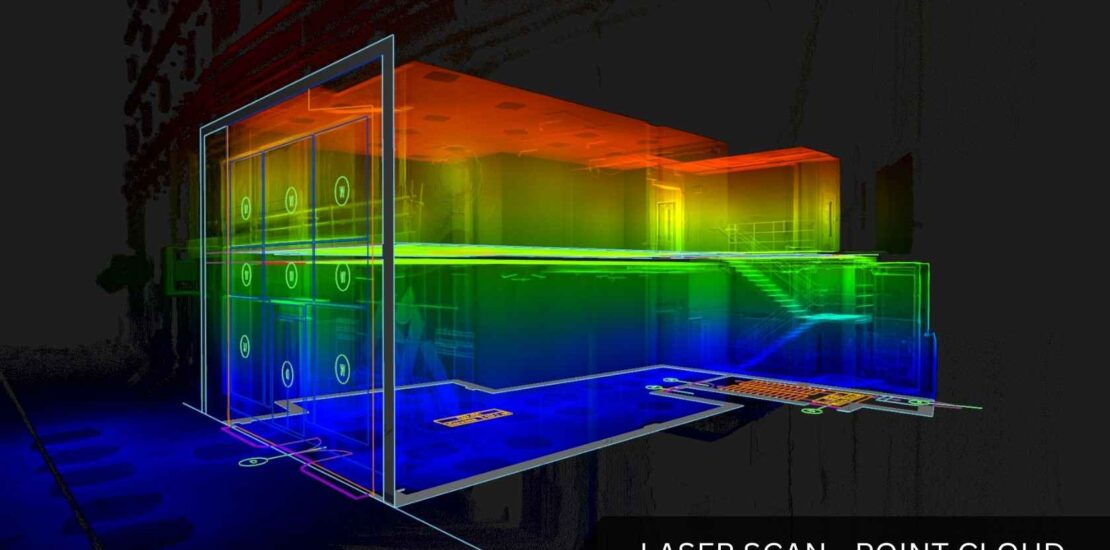
It’s becoming increasingly common for project teams to be spread across the country, or even across the world, making physical site visits hard to coordinate, expensive and time-consuming. When key decision-makers and designers aren’t all local, there is a real risk that vital details are missed during the initial visit, forcing repeat trips that slow everything down. Fortunately, 3D laser scanning services provide an efficient way to capture the site once, in full detail, so the whole project team can explore it remotely and confidently make decisions without being physically on site.
How Does 3D Laser Scanning Work?
3D laser scanning is a non-contact measurement method used to capture data. Specialist equipment records the exact positions of surfaces, edges, and features, generating a highly accurate “point cloud” that becomes the basis for a digital twin of the building or environment. This technology turns the physical site into a highly accurate, navigable 3D dataset that can be revisited at any time.
Unlike traditional tape measurements, 3D laser scanning services capture everything in their field of view rather than only the items the surveyor chooses to measure. This means fewer blind spots and surprises later in the project. With professional-grade equipment from globally recognised brands such as Leica, FARO, Matterport, and AutoDesk, engineers, architects, and contractors can be confident in designing and coordinating work directly from scan data without having to constantly visit the site.
Capturing Complete Site Data in One Visit
One of the biggest causes of delays in construction projects is incomplete or inconsistent site information. A surveyor may measure what seems important at the time, only for a designer to realise later that a beam, service route or floor level is missing. With 3D building scanning, the goal is to capture the entire space comprehensively during a single site visit.
Since 3D laser scanning uses advanced equipment to capture data at a high level of detail, large and complex spaces can be scanned quickly with minimal disruption to the existing site. This is particularly valuable in used environments such as retail shops, offices, or hotels, where downtime needs to be kept to a minimum. Once the scanning is complete, the project team can extract everything from floor plans to 3D models from the same point cloud data, rather than returning to the site each time a new measurement is required.
For global teams, this capture once approach is invaluable. In a project for Aldo, for example, a detailed scan was carried out in London and converted into accurate CAD outputs. The project architect, based in Canada, was able to view the entire space remotely as if they were physically present. This avoided long-haul travel, enabled faster design decisions and kept the project moving forward without waiting for additional site inspections.
Reducing the Risk of Missing Information
Traditional surveys rely heavily on experience and judgment; the surveyor decides what to record and what to leave out. Even with the most skilled professionals, there is always a risk that a detail will be overlooked because it doesn’t seem important at the time. When that detail later becomes key to the design or construction phase, it leads to urgent questions, rushed site visits, and avoidable delays.
3D laser scanning significantly reduces this risk by capturing the entire field of view with millimetric precision. Every aspect of the building that the scanner can see becomes part of the digital record. If the design team needs an additional dimension weeks or months later, they can go back to the point cloud data rather than the site. This is where a 3D building scanning service really proves its value; fewer data gaps mean fewer surprises and fewer last-minute changes.
High-resolution laser data capture also reveals issues that might not be obvious during a quick walk-through, such as out-of-plumb walls, uneven floors or clashes between structure and services. Identifying these early allows the team to make adjustments before work starts on site, rather than discovering problems during construction.
Minimising Clashes and Rework
Design clashes are a common cause of rework and project delays. When different contractors work from outdated or inconsistent drawings, it’s easy for mechanical, electrical, structural, and architectural elements to need the same physical space. Fixing these clashes once materials are ordered or installed isn’t just disruptive; it’s also expensive.
By using up-to-date 3D laser scan data as a single source of truth, project teams can use the same drawings or models that reflect the real-world conditions with +/- 2 mm accuracy. Whether the output is a detailed BIM or CAD drawing, designers know they are working from as-built information. This significantly reduces the likelihood of clashes between proposed works and existing structures, particularly in projects where nothing is perfectly straight or level.
When clashes are considered from the outset, potential issues can be resolved virtually instead of on-site. This not only reduces the project timeframe but also reduces rework, waste and the need for reactive site visits to resolve unexpected problems.
Keeping Projects on Time and Budget
Site re-visits aren’t just inconvenient; they are costly. Each additional trip to the site needs time, travel, accommodation and staff resources, and can delay design decisions or approvals while teams wait for updated information. Throughout a project, these small delays add up, pushing timelines and increasing overall cost.
3D laser scanning improves the information-gathering stage. It captures everything the team is likely to need in a single visit, reducing the need to return to the site for additional measurements. Since the data can also be delivered in formats compatible with all major CAD and BIM platforms, it integrates seamlessly into existing workflows, allowing designers and contractors to get started quickly.
The flexibility of 3D building scanning also supports risk management. If the project scope evolves or a new stakeholder joins late, the existing scan data can be revisited and repurposed without revising the site. This improves decision-making at every stage and makes it easier to maintain budget control amid change.
Enabling Remote Collaboration
For teams spread across regions or continents, accurate 3D laser scanning and digital twins provide a shared reference point. Instead of relying on flat drawings and written descriptions, everyone involved can use a realistic 3D representation of the site, rotate views, compare measurements and annotate areas of interest.
This is especially valuable when specialist input from consultants is needed, but they can’t visit the site. As in the Aldo store scan-to-CAD project, an architect or engineer based overseas can review the space in detail, test design options, and sign off on key decisions without ever setting foot on site. This level of remote collaboration reduces bottlenecks, improves communication and ensures that decisions are based on accurate information.
Why Work with Surveyhands Engineering?
If you want to reduce site visits, avoid delays and give your distributed team the confidence that they’re working with accurate as-built information, speak to our team at Surveyhands Engineering. We provide professional services that create precise digital twins using state-of-the-art equipment. The 3D laser scanners operate without contact, capturing highly detailed information without any damage, and can quickly digitise complex areas that would be extremely difficult to measure by hand.
With a rapid data-collection process and high-resolution point cloud outputs, we provide data that project teams can trust. The outputs can be supplied in various formats, including CAD drawings, BIM models and 360 virtual tours. 3D scanning has become a vital tool in modern construction and design, and we pride ourselves on offering unmatched efficiency, accuracy and flexibility compared to traditional methods to keep your programme and budget on track.